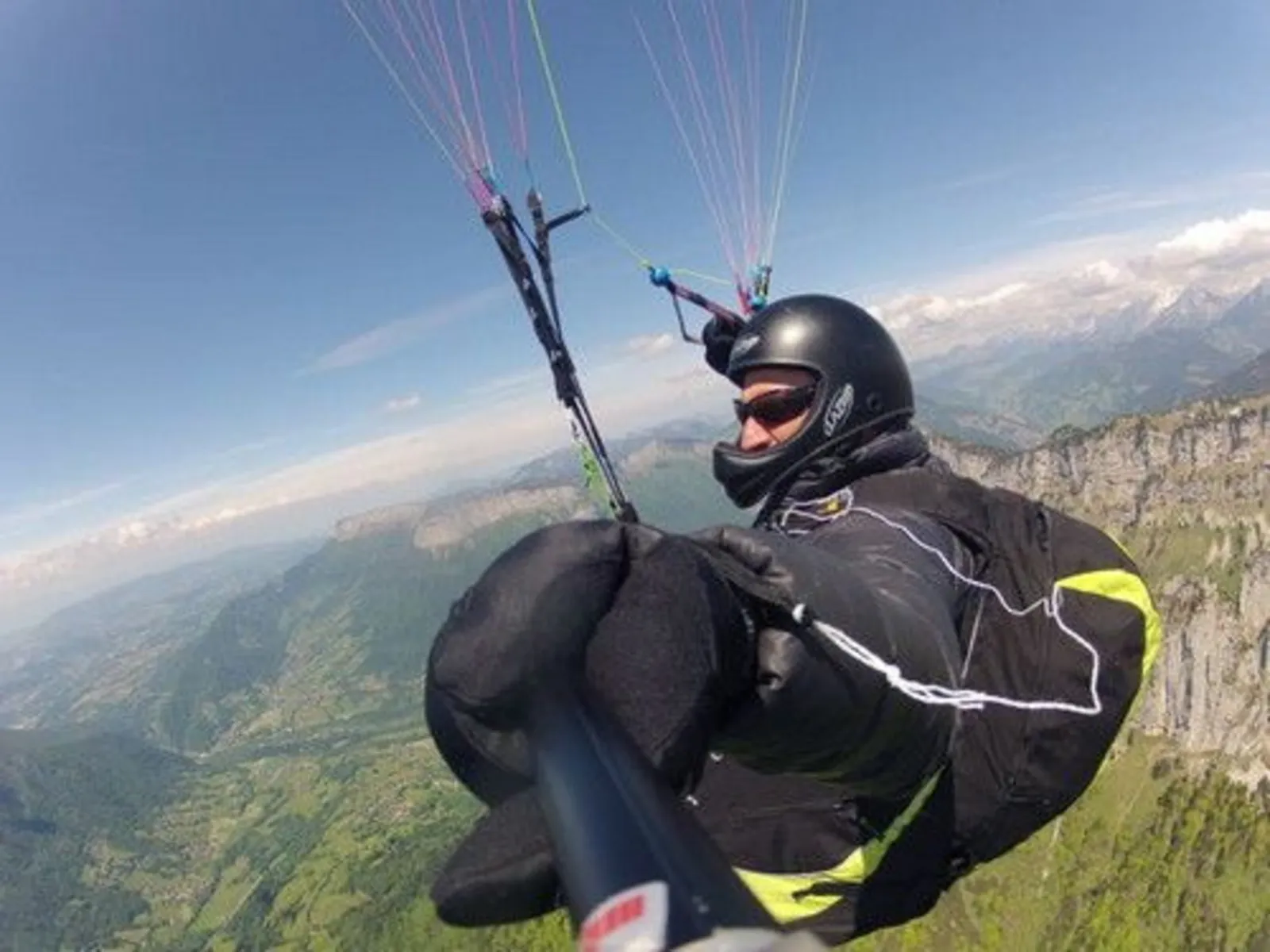
This surprising story began in Tignes over a coffee in 1993. Laurent Lapeyre and I were living in Tignes, teaching paragliding at the school we had set up three years earlier. Worth knowing: in Tignes it snows every month of the year. When we'd fly back down into the valley in May, we'd appreciate the little flowers and the lush green pastures — while up above there was still two metres of snow. Our favourite seasons were winter and spring. We loved skiing and paragliding; for skiing, Tignes is a fabulous spot, and in spring the flights over the Tarentaise, Sainte-Foy, Les Arcs and the Aiguille Grive are breathtakingly beautiful. That particular morning it wasn't flyable — the southerly was too strong — so we met up at the café with our friend Laurent Chelle and talked freely about sport and business. We were convinced you could make a living from outdoor sports year-round while actually enjoying it, and that you could bring the mountain resort economy into the city. Laurent Chelle knew the whitewater sector well; we knew snow sports and free-flight. We were onto something, but we weren't quite sure what. We'd been self-employed for four years and had known both the lean times and the busy rushes. Laurent Chelle, who was running the local youth hostel, kept developing the project but eventually stepped back — years later he became director general of the Les Arcs resort!
There was no question of stopping. We decided to set up in Annecy, a place I knew well — I'd grown up there and gone to school there before heading to the University of Grenoble, where I'd met Laurent. We did three years of sports science, getting our paragliding and ski instructor qualifications at the same time. During the holidays we worked at ski schools to fund our studies, then Laurent did a fourth year in Lyon in marketing and sports facility management, followed by a fifth-year postgraduate degree at the IAE. I wasn't accepted, so that was it — time to earn a living. Laurent joined me in Auron where we cut our teeth, then came the Tignes years and that famous coffee on a southerly-wind day.
Annecy — which would go on to become the world capital of outdoor sport — is a magnificent city with its lake and mountains, an eldorado for our sports, an exceptional playground. But how and where to set up? Everything was expensive and we had no money.
1994 — We decided to rent a tiny shop in the Faubourg Sainte-Claire. The business would be called TAKAMAKA. In this street made up mostly of restaurants, everyone said we wouldn't last three months. And indeed it was tough. Our outdoor-sports-in-the-city concept didn't attract people at first; getting known was hard. The first summer was a bit busy — paragliding, canyoning, bikes, all crammed into 17 square metres. In winter our offerings didn't take off, so to make ends meet we went back to ski school and kept flying with our clients. The competition was fierce: paragliding schools, well-established guide bureaus — the Annecy guide bureau even had a kiosk at the Annecy tourist office.
TAKAMAKA is the name of a canyon on Réunion Island that we discovered on a trip; it's also the name of a type of wood native to Madagascar. The name sounded good, so we adopted it and decided to see how things went. The brand logo — two intertwining boomerangs — came about with Claude Saint-Romain, an applied arts teacher, when we found the idea in a book on Aztec art; she styled it and gave it to us as a gift. It symbolises movement in Aztec art; we added values of connection, solidarity, team spirit, creativity and performance. That logo still represents the TAKAMAKA brand today.
1996 — Our first real encounters. During a conversation with the then deputy mayor, Mr Jean Régis, we raised the subject of a competition that had entrenched advantages, even privileges. He said: "Stop complaining — mountain professionals, do like TAKAMAKA: they don't ask anyone for anything and they're doing just fine." "Monsieur Jean Régis, we are TAKAMAKA." "OK — my office, tomorrow." Annecy then decided to support and promote the sector, helping it become what it is today. During those first two years, we subcontracted our whitewater activities through AN Rafting, run by a certain Olivier Arche.
That same year, Camille and Marian — Laurent's sons — and Titouan, my son, were born. Time to get serious: we were fathers now!
1997 — A client we'd flown with from the Semnoz asked us to organise a themed day for the managers of his company, HP. There were 50 of them, and the theme was James Bond!
Fifty people at once — a company event with a Bond theme. We went wild. The day would be called "To Jump Is Not To Play". On the programme: canyoning, paragliding (all the instructors in suit and tie at the Pricaz takeoff at La Forclaz) and a glamorous evening with a transfer in vintage cars. It was our first corporate event. We discovered a new area of activity built around the values that sport conveys. TAKAMAKA was up and running.
That same year, the Les Trésoms hotel in Annecy was taken over by the Droux family. A wonderful meeting and the start of a lasting friendship. TAKAMAKA's journey is punctuated by these stories that endure — with clients, partners, suppliers.
1998 to 2000 — We were still in our tiny premises on the Faubourg Sainte-Claire. It was getting cramped. We rented the studio upstairs, cut a hatch through the ceiling, and hired our first employee. She left five years later, ostensibly to travel the world — which turned out to last two months — and then set up a competing business with one of our river guides. Welcome to the real world of running a company: a field we knew nothing about, discovering everything new every day. Fascinating but precarious.
2001 — The company had built up a good reputation in team building, corporate events and business tourism. We connected with a small whitewater base at Alby-sur-Chéran: KOKOPELLI, run by Nadine and Jean-Claude Banfi. We worked together for two years before going our separate ways. The years on the Chéran — that superb river just a stone's throw from Annecy — left their mark on our whitewater story. We discovered, we specialised, we paddled with hundreds of clients. The activity was a hit, but the story ended due to a water-flow regulation issue on the river.
2002 — We took on two six-month final-year interns: Bruno Donzel and Emeric Pouchot. They had boundless energy and moved TAKAMAKA forward through their attitude, warmth and skills. I mention them because they're still part of the story, with a few twists along the way.
2002 — The Battle of La Forclaz. We were working across three distinct markets: corporate clients, works councils and individual customers. At the Col de la Forclaz on the commune of Montmin, south of Lake Annecy — a well-known paragliding site — competition was fierce. The local council decided to open a new site and handed its management to a private operator who locked out other professionals. In response, we rented a strip of land at the landing zone to stand our ground: they couldn't take off, we couldn't land — a stalemate!
An important figure in our story is Daniel Millet, the Dalai Lama of free flight. He'd been flying since the beginning, in hang-gliding and paragliding, and he's someone who truly shaped the history of the sport — and who helped, supported and assisted us. He was demanding and passionate. So many arguments with Daniel, but what a great friendship. He pushed us to improve our organisation, brought processes and rigour. In 2010, Daniel stopped flying after an accident on the Tournette, but he remains an indispensable friend of TAKAMAKA. We fought alongside our fellow professionals — tenants of the takeoff site — and eventually reached a consensus. Our solicitor counselled us like a wise elder: "Better a bad settlement than a good lawsuit." Today the site has been beautifully developed, it's open to everyone, and it generates work for over 40 professionals.
In 2003, Emeric Pouchot — our famous intern — called to say he wanted to join the TAKA team. We'd already hired Bruno Donzel, his fellow intern, and Benoît Schnoeringer, the aeronautical engineer who had given the brand a new momentum. We didn't have a role for Emeric — and yet we already sensed he'd be the key man of the future. He'd just spent a year at Adidas in their events department. He had incredible energy and real skills. We shared the same values: a sense of welcome and care for clients, an honesty in relationships. After a few days' reflection, we called him back and proposed setting up TAKAMAKA Aix-les-Bains. We were already working on the site and knew that to perform better and offer our clients better services, we needed to be on the ground where we operated. We asked him to think it over. The next day, without knowing exactly what he was signing up for, he said "banco" — he was in. In for what, exactly, we weren't sure either. He created a new legal entity in which we held 51% and he held 49%, and he developed the first TAKAMAKA agency outside Annecy. The expansion of the brand had begun. A year later, he hired one of his interns, Sophie, who stayed with us for eight years. Another person who shaped the TAKA story — she's now commercial director of a partner hotel.
Those were the early days of the internet. We hired Antoine Lacoquerie to develop TAKAMAKA's image online, then built our first websites with Bernard from Annecy Bernard — Artisans du Web. He was a character who claimed Google didn't know us, but he knew Google very well. In the 2000s he made headlines by filming his tax audit via webcam. Quite a stir in administrative circles — could such a thing be allowed? We never found out how it ended, but we chose him because he was unconventional and that suited us. In the same spirit, there was also our accountant, Monsieur Vésin, whom we chose because he told us: "Your project isn't viable — but I believe in it, so I'm coming with you for 5,000 francs." He knew we had no money. His daughters, who took over the firm, now manage the 12 companies in the group. Well played, Monsieur Vésin.
After that the chronology gets a little blurry, but we met Olivier Martel — king of paragliding acrobatics — and opened TAKAMAKA EVIAN. We initially took on the concession at the Beunaz beach in Saint-Paul-en-Chablais, working across all sectors as in Aix and Annecy. Olivier brought new expertise with Parapente Shop, selling paragliding equipment online. You can see the profile: acrobatic paraglider, online equipment sales, a choice between opening one kind of business or a TAKA — and he came with us. Incredible coincidence: years later the management of La Panière, the Cantenot family, would become our clients and our friends. It was up there at La Beunaz, on the beach of the legendary diver Casa, that I first met a young man called Baptiste Cosson, working the summer season as a waiter. He was so passionate about skiing that we never managed to bring him into the TAKAMAKA adventure — but our paths would cross again later.
Benoît Schnoeringer, drawing on his experience in Annecy, decided to open in Biarritz — a destination rich in meaning, the seaside equivalent of Annecy. He took up surfing, built a great image around his surf shop, and welcomed clients from all over the world. Benoît is one of the pillars of the brand. If you travel to the Basque Country, go and say hello — he'll know how to welcome you.
2005 — The battle with the authorities: tax audit, URSSAF inspection, trading standards, labour inspectorate. These were gruelling years. Laurent faced them with courage. Each time we came out with more expertise and slightly less money — but not too much less. The tax authority validated our travel-agency accounting model for individual clients; trading standards approved our procedures; URSSAF commended us and found only one bank error in the set-up of a company savings plan; and the labour inspectorate flagged some irregularities which we corrected without penalty. Given how frequent and regular these inspections were, we decided to lean into them and take advice to improve our practices. Meanwhile, we had to keep producing and selling.
2005–2006 — We hired Ludovic Lequeux, a sailing specialist, to develop our remote-destination offerings, and Benoît Lemar, a mountain specialist. Both former interns, they found their place in Annecy and became pillars of the Annecy agency.
Ludo recalls his years at TAKA:
"Intern from April to September 2005, then hired in October 2005 at the end of my placement. At the time there was no room for an extra employee in the Annecy office — I knew this before my internship. What I did know for certain was that Alain and Laurent wanted to keep me in their team. They asked me to think about creating my own role. Flattered, I explored two avenues. One project around managing a woodland trail came to nothing — but I was determined to be part of this adventure! I wanted to work in this sector and join this remarkable human story that was Takamaka. I remember it like it was yesterday: on a beautiful autumn day, we met on a terrace in the Old Town. We talked, and almost before the ink on my contract was dry, I was off to Paris to gather as much information as possible and launch myself into my first 'real' job! Imagine: I was euphoric — I'd hit the jackpot. My mission: to develop the Off Road service, bringing our expertise beyond the two Savoie departments — Champagne, Burgundy, the Côte d'Azur, the Lyon region… Before Takamaka I had no experience of corporate events, so it was all brand new — despite my background as a sailing instructor and various professional placements during my sports management and sports events studies. What a challenge. That, in a few lines, is the beginning of my Takamaka story. Today, after several years devoted entirely to that service, and as Takamaka has evolved, I've refocused on the Annecy office where I'm now head of the corporate events team. I'm proud to have been part of this human-scale company for seven years."
In 2008, Fred Boidin arrived and opened the first mountain agency, in La Clusaz. He's a high-mountain guide, ski instructor and paragliding instructor — hard-working and tenacious. He quickly found his footing in the mountain community and posted remarkable turnover figures. He applied the military methods he'd learned during his years with the PGHM (high-mountain police rescue). A world neither Laurent nor I knew — neither of us had done military service — but it was effective, even if it shook up our habits. We had to understand, integrate and cooperate with this new approach.
2009 — The crisis. Our sector took the full force of the global downturn. Companies that used our services froze their budgets; we lost 30% of turnover. We watched a cascade of bankruptcies: LSO closed, Capital Event, Courant Chaud. We resisted as best we could by refocusing on our core trades — producing outdoor sports experiences for individual clients — and by bringing corporate event production back in-house. We just scraped through the low point, but we stayed standing.
That same year, in the middle of the crisis, we opened in Strasbourg. The launch was a disaster; we were only just emerging from that critical situation in 2011.
That year also saw an innovation in how our services were distributed: the famous gift vouchers — Smart Box, Happy Time and the like. We found ourselves in supermarkets, at Fnac, at Carrefour. A brilliant idea — but our margins plummeted. Our individual clients were now coming from all over France, and we had to learn to manage that: when someone travels 800 km to go paragliding, the weather had better be good! So we changed our pitch — we talked about the destination and encouraged clients to plan visits and make the most of the area even if the weather didn't cooperate. We never managed to get Météo France to guarantee sunshine.
2010 — The crisis continued; we were struggling. Olivier Arche from AN Rafting — our first whitewater supplier — called us at the end of November. One metre of snow had fallen on Annecy; the whole city was at a standstill, magnificent, like Tignes on a storm day. He could no longer cope financially and needed help — now.
Emeric had sold his stake in TAKAMAKA Aix-les-Bains to Fred, our La Clusaz colleague, three months earlier. We were happy for Fred, who became a new partner, and sad to lose Emeric. Bruno Donzel, who had gone off on a round-the-world trip, took over the management of the La Clusaz agency. He's a native of Thônes, he loves his clients, and he has a real sense of service — the ideal candidate.
We reached an agreement with Olivier Arche and proposed to Emeric — who had been finding his feet for a few months — to take a stake in AN and run it. We bought AN Rafting at the commercial court auction in December 2010. So there we were with three rafting bases, a hydrospeed operation, a hotdog boat, two restaurants and land to manage — operations on the Dranses near Thonon-les-Bains, on the upper Isère at Aime, and on the Cure in the Morvan. Thirty seasonal staff, 25 years of history. A new adventure began, with Emeric at the helm and Olivier — the memory of AN — staying on as a partner in the new structure. We even bought a plot of land by a river in Saint-Clément in the Hautes-Alpes. If you ever feel like going camping there, let us know what you think!
In 2012, after ironing out the wrinkles of the takeover, we relaunched the activity, welcomed 12,000 clients who had a great time on a descent or a weekend, and ended with a first positive balance sheet — not by much, but positive: the first in over 15 years for AN Rafting. We then decided to buy the land on the left bank where our Aime restaurant stood.
In 2012 we also turned our attention to our development: how to keep growing without exploding. We met a former AN river guide, a friend of Olivier Arche — Jean-Claude Brun, who had become a lawyer specialising in brand development. He proposed a licensing model. Emeric would be the first to use the TAKAMAKA brand licence, in the Tarentaise valley.
TAKAMAKA thus opened its services in the Tarentaise valley in the summer of 2012.
In 2014, Ludovic left the company, as did Benoît — who returned six months later to open TAKAMAKA Lyon under a brand licence. Yoann Arnoult and Marie-Charlotte Micoud joined the commercial team for the business tourism side. The 2.0 generation was rolling, bringing fresh momentum to the Annecy agency. The Lyon agency got off to a superb start, posting turnover of €350,000 in 2015.
Laurent has been active at the board of the Greater Annecy tourist office since 2008, representing sports and events providers. He sits alongside Pascal Droux and Mr Cavali — who, together with Jean Régis, gave outdoor sport in Annecy its initial boost back in 1994.
I myself have been involved for eight years with the Annecy Sports Club, which specialises in training young people in competitive skiing, with a high-performance stream. In 2010 we hired Baptiste Co